
Discover essential FX hedging strategies and currency management best practices from our foreign exchange experts.
FX Hedging Programs: How to Manage Currency Risk


FX hedging strategies are the business rules companies use to systematically reduce currency risk and limit the impact of exchange-rate moves on financial performance. For corporate finance teams, currency managers and risk managers responsible for FX programs, the main choices are micro-hedging, static hedging and layered hedging, with combinations used when exposures require more precision. Micro-hedging programs cover both balance sheet and cash flow hedging, while static and layered programs focus on cash flow hedging.
There is no one-size-fits-all FX hedging program. The right setup depends on management goals, the pricing characteristics of the business, the forecast horizon and the interest rate differentials between currencies. Getting that choice right helps protect profit margins, defend budget rates, achieve smoother hedge rates and reduce financial statement volatility—all critical for financial stability and planning accuracy in international business.
With Currency Management Automation, finance teams can implement automated FX hedging programs powered by Kantox Dynamic Hedging®. This article explains what FX hedging programs are, how the main strategies work, how to choose the right program for your business, the operational challenges companies face, and how automation improves execution, visibility and control.
What is an FX hedging program?
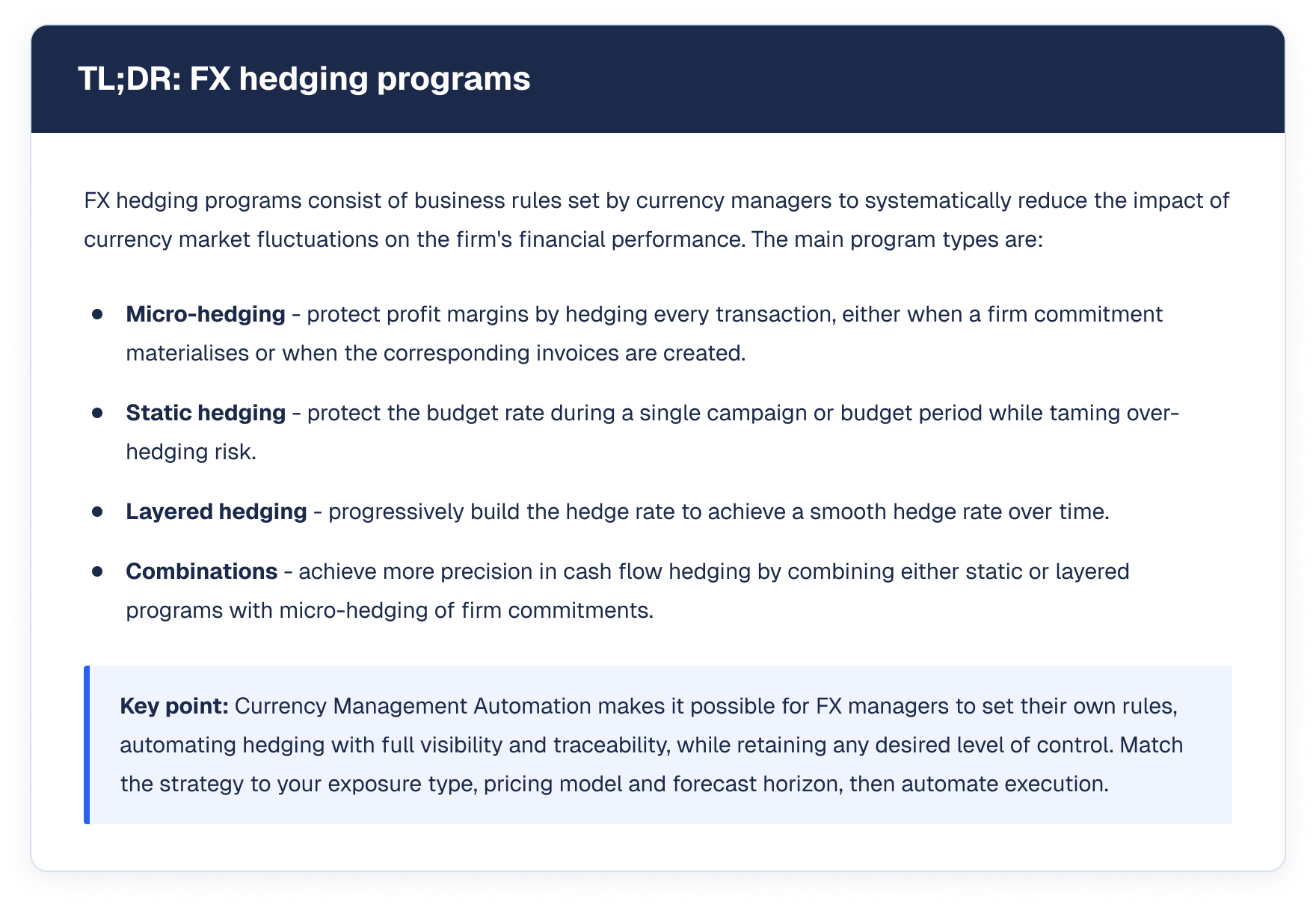
A FX hedging program is a set of business rules created by corporate managers to reduce the impact of currency fluctuations on financial performance. As a broader risk management strategy, it helps manage currency exposure through currency hedging that can combine financial derivatives and other financial instruments with operational hedging solutions. The main goals of an FX program include: defending a budget rate, achieving a smooth hedged rate over time, hedging transaction exposure to secure profit margins, or reducing the impact of FX gains and losses on financial statements.
Natural hedging is a risk management approach that matches foreign-currency inflows with outflows in the same currency to reduce exposure.
Invoicing in the company’s home currency transfers FX risk to the counterparty.
When implementing a hedging program, managers can also establish secondary objectives. Usually, this involves optimising discrepancies between spot and forward rates —known as forward points— that result from interest rate differentials between currencies.
When forward points are unfavourable, programs can be configured to reduce their impact by delaying hedge execution, shortening duration, or increasing hedge granularity. When they are favourable, margins can be enhanced with the opposite instructions.
Any program configuration must consider possible constraints such as the degree of forecast accuracy and the ability to execute long-term hedges with banks.
The main FX hedging programs
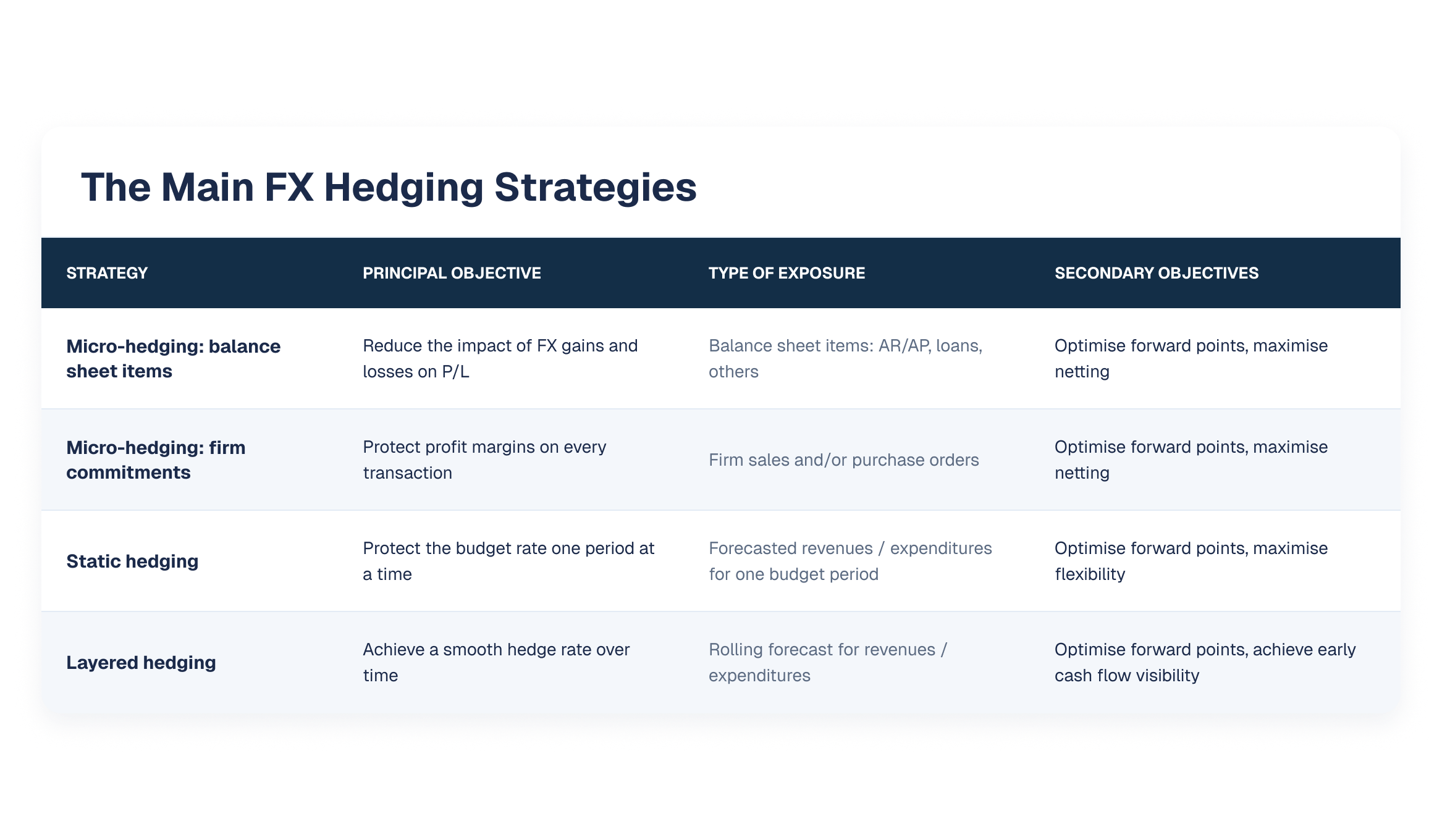
In cash flow hedging, the indicated program depends chiefly on the underlying pricing parameters of the business. When a company frequently updates its prices, a micro-hedging program for firm commitments is in order.
As broader forex hedging concepts, the main forex hedging strategies are a perfect hedge and an imperfect hedge, which differ from the corporate programs outlined below. A perfect hedge pairs a long position with a short position at the same time on the same currency pair as two opposing positions on the same pair, while an imperfect hedge uses forex options such as vanilla options or other options contracts to create an offsetting position against an existing position or one position moving in the opposite direction; for example, a call option gives the right to exchange currency at a specified price or set rate tied to a strike price, not the obligation to transact, so this broader forex hedging strategy can help reduce certain risks and adverse movements but does not eliminate risk entirely.
When prices are updated at the end of a campaign or budget period, as in catalogue-based pricing, the goal of the FX hedging program is to protect the budget rate, one period at a time.
Finally, in cases where management needs or desires to keep prices as steady as possible, for as long as possible, layered hedging is indicated.
In balance sheet hedging, the accounting exposure is best hedged with a micro-hedging program for items such as accounts receivable / payable, intercompany loans and other FX-denominated assets and liabilities.
Micro-hedging
A micro-hedging program is one of several hedging solutions for firm commitments and balance-sheet items, using conditional stop-loss and take-profit orders around a constantly updated average exposure rate. This makes it possible to accumulate small pieces of exposure that are hedged as conditional orders are triggered, including FX orders such as limit, stop loss, and OCO orders.
In cash flow hedging, the exposure consists of firm sales and/or purchase orders for which no AR/AP has still been recognised. By hedging the FX risk between the moment an order is agreed and its settlement, micro-hedging protects the firm’s profit margin in every transaction. This is particularly well suited for firms that frequently update their prices.
Micro-hedging is also used in balance sheet hedging, where the exposure consists of AR/AP, intercompany loans and other pieces of FX-denominated assets and/or liabilities.
Static hedging
A static hedging program protects the budget rate during an individual campaign or budget period, often using a forward contract or FX forwards to lock in the exchange rate for that window. This setup answers the needs of a company that typically updates its prices at the start of a new campaign period, since these over-the-counter derivatives are tailored to the company’s hedging needs and can lock in a rate for up to two years.
Best practices in stating hedging feature the use of conditional stop-loss (SL) and take-profit (TP) orders around the budget rate. To the extent that markets trade inside this corridor, hedge execution is delayed. This procedure allows currency managers to:
- flexibility update forecasts
- lower the cost of hedging (with unfavourable forward points)
- uncover exposure netting opportunities
- lock in potentially favourable FX rates
- optimise collateral
Layered hedging
A layered hedging program runs continuously against a rolling forecast of foreign-currency cash flows. For each value date in the forecast, the program builds the hedge progressively, triggering a small layer at each scheduled interval until the value date is reached. This rolling approach helps manage FX exposures by closing and reopening forward trades monthly or quarterly as forecasts evolve. FX swaps can support the process by exchanging currency now and reversing the transaction later.
The resulting blended hedge rate date moves only a little from one value date to the next. This gradual transition removes the period-over-period jumps that ordinary hedging —or the absence of hedging— would create.
Three properties define a layered hedging program:
- It is mechanical, not predictive. The smoothing comes from the schedule, not from a view on where rates are headed.
- It relies on rolling forecasts. The program needs forward visibility, which only the forecast stage provides.
- It requires automation. Trades need to be executed at the same spot moment, a difficult undertaking at scale.
How to choose the right hedging program for currency risk
To choose a hedging program that systematically achieves its stated goals —as opposed to reaching them by chance— currency managers need to acquire a thorough understanding of the drivers of the underlying business, with the aim to hedge FX risk from exchange rate fluctuations affecting businesses and investors in foreign exchange activity. The main element to consider is the pricing parameters of the firm.
In a business that keeps steady prices over several budget periods, a program to defend the budget rate one period at a time would not do the job. The firm’s FX goals could still be reached, but only by chance, if the exchange rate does not display big fluctuations —known as ‘cliffs’— at the start of each campaign.
Firms may have different lines of business, each with its own pricing parameters. For example, Netflix uses a layered hedging program for its streaming business. However, the company’s relatively new advertising business would probably require a micro-hedging program for firm orders, a completely different setup.
Choosing the right hedging program involves additional considerations. These include the situation in terms of forward points as well as possible constraints in terms of forecast accuracy and the company’s ability to execute long-dated currency trades. All these scenarios must be carefully assessed before choosing a program, and the choice should also reflect market conditions and market volatility, since both affect how well a hedge protects cash flows and potential profits.
Common challenges when running a hedging program
Manual execution is the most common challenge faced by finance teams when implementing a hedging program. Companies that run these programs on large spreadsheets take on two operational risks: spreadsheet risk (input, copy-paste, formatting and formula errors) and key-person risk, where only a few people understand the formulas that underpin the models.
In layered hedging, for example, a precise schedule for hedge execution must be respected. If managers are serious about achieving a smooth hedge rate over time, all the hedges corresponding to a given trade date must be triggered at exactly the same time.
This is because the same spot rate element, in forward transactions with different maturities, achieves the ‘smoothing’ effect. In a two-year linear program for one currency pair, 144 currency trades need to be executed. Clearly, the challenges of manual execution grow exponentially when several currency pairs are used.
Automating your hedging strategy with Currency Management Automation
With Currency Management Automation, risk managers create business rules aimed at systematically achieving the firm’s FX-related objectives and supporting a broader set of hedging solutions for managing risk in the fx market. Once the business rules are set, the FX workflow is managed in accordance with three pillars: automation, visibility and control.
End-to-end automation starts as the exposure is captured: firm orders, balance sheet items or forecasts. The trade phase routes forward transactions to corporate FX trading platforms that put liquidity providers in competition with each other, ensuring best-price execution.
Some workflows may also incorporate options trading, including premium-free options that limit losses but cap potential upside, depending on market moves and the company’s objectives.
Treasurers instantly visualise the P/L of trades, the forward point impact, the number of entries per trade and much more, including exposures across entities and base currencies. The processes of swap execution and hedge accounting can also be automated—with manual checkpoints available, if so desired, at each part of the workflow.
FAQs about FX hedging programs
- What is an FX hedging program? An FX program is a set of business rules created by a company’s finance team with the aim of systematically achieving its FX goals. These goals vary according to different business models. In cash flow hedging, the main goals include: protecting profit margins on every transaction, defending a budget rate one period at a time, or achieving a smooth hedge rate over time. In balance sheet hedging, the main goal is to reduce the impact of FX gains and losses on financial statements.
- What are the main types of FX hedging programs? There are three main types of cash flow hedging programs: micro-hedging, static hedging, and layered hedging. In micro-hedging, the exposure consists of accumulated FX-denominated sales/purchase orders. In static hedging, the exposure is in the shape of budgeted revenues and/or expenses, one budget period at a time. In layered hedging, the exposure is a rolling forecast across several budget periods. These programs help businesses and forex traders with reducing risk across asset classes, but hedging does not guarantee net profit and firms can still lose money.
- What is layered hedging? Layered hedging programs build the FX rate in advance by implementing successive layers of hedges ahead of the value date. Because it creates commonality between hedge rates, the program achieves a hedge rate that displays little variability between value dates. This is particularly well suited for companies that need or desire to keep prices as steady as possible, for as long as possible.
- Which FX hedging program is best? The best FX hedging program is the one that reflects the underlying business of a company, especially its pricing parameters.. A company that updates prices frequently should protect profit margins in every transaction by using micro-hedging. For catalogue-based pricing, static hedging is indicated. Finally, layered hedging is best suited for companies that need or desire to keep prices as steady as possible over time.
- Can FX hedging be automated? FX hedging can be automated in its three phases: pre-trade, trade and post-trade. From capturing the exposure (pre-trade), to executing FX trades, and all the way to swaps and hedge accounting (post-trade), Currency Management Automation uses API connectivity to execute all the steps of the workflow, with visibility and control throughout the process, including support for additional positions in forex trading across two currency pairs or the US dollar when firms need to manage broader FX exposures under changing financial markets.


.png)
