
Discover essential FX hedging strategies and currency management best practices from our foreign exchange experts.
What is FX cash management?


TL;DR: FX cash management
- FX cash management is the practice of managing a company's cash and liquidity across currencies while controlling the currency risk that comes with it.
- Cash management and FX risk are connected: currency moves change the value of cash flows, so they cannot be managed in isolation.
- Forecasting matters, but not every exposure needs the same accuracy - firm commitments run on near-certainty, anticipated exposures on graduated precision.
- Treasury automation links forecasting, liquidity and hedging into one workflow, improving visibility and control.
- The result: fewer silos, better forecasts, and currency risk managed as part of cash management rather than after it.
“Cash is king” is a well-known corporate finance mantra. In practice, FX cash management is the daily process of collecting, handling, and using cash while adjusting FX hedging positions to the settlement of underlying commercial transactions.
For firms that hedge currency risk, cash management becomes more complex because payment dates on hedged cash flows often change. Corporate treasurers and finance teams—especially those in small-to-medium sized businesses—often use currency swaps to keep hedges aligned with those moving settlement dates and to manage FX risk without disrupting cash flow.
When handled manually, that work is painstaking and time-consuming, creating operational risk and stretching already limited treasury resources. This is why the link between cash management and FX risk matters in day-to-day treasury operations: delays, errors, and inefficient execution can quickly raise cost and workload.
Advances in FX automation are bridging that gap. This article looks at how swap automation, including ISO20022-enabled payments and financial messaging, simplifies manual FX cash management, reduces operational strain, and helps treasury teams manage new payment standards more efficiently.
Why cash and currency risk management are connected
In many industries, a myriad of factors, both internal and external, can lead to uncertain deliveries of the goods that have been sold. As a result, corporate treasurers frequently adjust their hedging position to changes in the settlement of the underlying commercial transactions.
A European furniture company, for example, may be notified by one of its USD-based suppliers that some deliveries, originally scheduled at a future date, will instead occur on the spot. The firm needs to do two things. On the one hand, it must obtain cash in USD. On the other hand, it has to adjust the original hedging position to avoid over-hedging.
In the opposite situation, when a delivery is postponed, the value date of the corresponding hedge must be rolled over to the new expected value date. These adjustments involve currency swaps. Here’s how Airbus describes the process:
"In situations where the payment dates for hedged firmly committed cash flows are not fixed and subject to potentially significant delays, the Company may use rollover strategies, usually involving foreign exchange swaps." — Airbus
Needless to say, these adjustments involve a heavy dose of painstaking cash management-related work.
Bridging the gap between FX and cash management
Ensuring a perfect match between the settlement of commercial transactions and the corresponding FX hedges is next to impossible. To bridge the gap between these positions, swapping is necessary. It is the ‘cash flow moment’ in FX risk management.
Currency swaps allows treasury teams to:
- Perform early draws on existing forwards
- Roll over existing forward positions
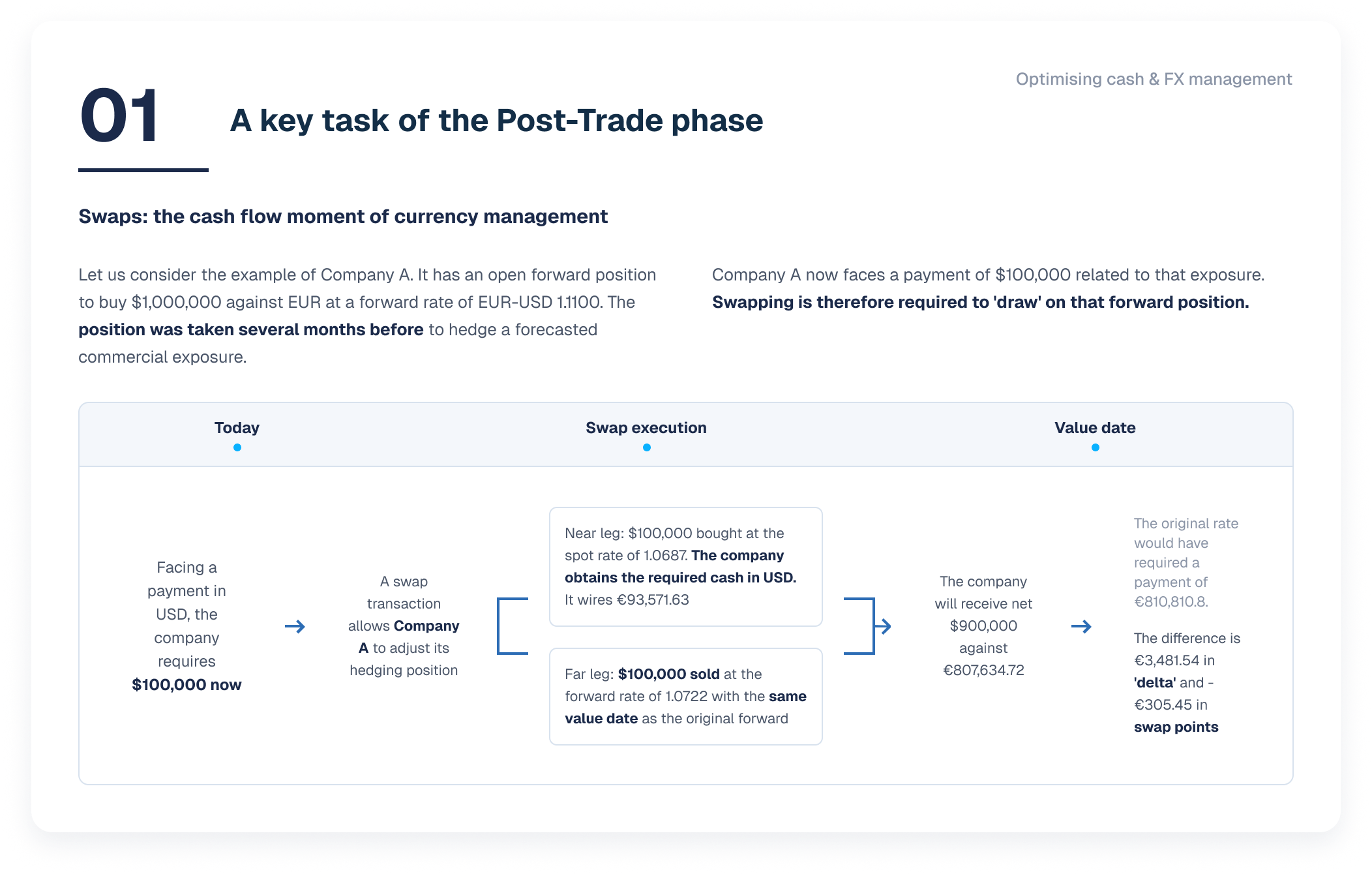
The illustration below describes a 'draw' transaction. As 10% of the planned delivery of $ 1 million worth of goods is anticipated to take place on the spot, the treasury team needs to make a cash payment of $100,000. It also needs to adjust the underlying forward position.
With the ‘near leg’ of the swap, the company buys the required $100,000 in the spot market. At the same time, the ‘far leg’ of the same swap transaction avoids over-hedging by selling the corresponding amount at the original value date.
The process just described involves a number of cash management related exertions, as payments and funds transfers to liquidity providers need to be adjusted.
Swap automation to the rescue
Treasurers know it too well: swapping is a complex and resource-intensive undertaking that carries operational risks derived from manual execution. Thankfully, swap automation provides relief:
“Swap automation frees up resources and removes operational risks. Whether they need to anticipate or roll over FX forwards linked to payments/collections, treasurers can execute the process in one click” — Ignacio Recalt, Treasury SaaS and Payments Product Owner at Kantox
With complete visibility and control, finance teams obtain:
- Swift integration with ISO20022
- Traceability between swap legs and the underlying forwards
- Granularity in terms of FX gains and losses and forward points
- IBAN and BIC setups integrated with the ERP and TMS
Thanks to API-based “chains” that link swaps to their corresponding forward positions, treasurers can see everything that happens with a position. For example, if they have ‘rolled over’ their position more than once, they have all the required traceability in the chain.
Created by Kantox, the chain concept provides a structured way to group and track all related modifications to an original hedge, ensuring transparency and automation in cash and risk management workflows.
(*) The illustration shows how PowerBI displays the traceability between swap legs and the underlying FX forwards of a hypothetical user.
New standards for payments and financial messaging
Here’s a real-life situation that we often encounter. A corporate treasurer executes trades on a given currency pair —say, EUR-USD— with one and the same bank. To adjust the hedging position to the settlement of the underlying commercial exposure, he/she always executes FX swaps with that bank.
The treasurer thus avoids the hassle of moving funds from one bank to the other. But there’s a catch: this procedure may deprive the company from taking advantage of FX platforms’ best-price execution functionalities. To steer clear of the extra cash management workload, the treasurer accepts higher trading costs.
With Pain.001, the ISO 20022 XML message standard that is set to replace the current MT101 “Request for Transfer” standard, the process is automated between banks. Say that the company executes a forward transaction with Bank B, as it provides the most attractive FX rate.
At the value date of the forward, Bank B does not have any USD from the company. With the message standards Pain.001 and its predecessor, Bank A funds the USD to Bank B, allowing it to settle the forward and credit the corresponding EUR amount in the corporate bank account.
“Without any extra cash management effort to move money between banks, the treasury team profits from the best-price execution functionalities that come with corporate FX platforms” — Niklas Bölt, Kantox Sales Team Manager DACH
Best-price execution of forwards, swaps and spots is therefore possible without worrying about where money will be settled. This begs the question: Is your team letting cash management issues get in the way of measurable cost efficiency?
FAQs


.png)
