
Discover essential FX hedging strategies and currency management best practices from our foreign exchange experts.
How to Automate Layered Hedging


In currency risk management, a layered hedging program runs continuously against rolling forecasts of foreign-currency denominated revenues or expenditures. For each future value date in the forecast, the program builds up the hedge over time, triggering successive layers of hedging at each scheduled interval until the value date is reached.
The result is that the blended hedge rate for each value date, the Weighted Average Hedge Rate (WAHR), moves only slightly from one value date to the next. That gradual transition removes the period-over-period jumps that ordinary hedging, or the absence of hedging, would create.
Three properties define layered hedging programs:
- They are mechanical, not predictive. The smoothing comes from the schedule, not from a view on where rates are going.
- They rely on rolling forecasts. The program needs forward visibility into expected cash flows, which the forecast provides.
- They rely on programmatic execution. At scale, manually executing trades across at all active value dates becomes impractical.
Why Layered Hedging Needs a Programmatic Schedule
There is a structural reason why a programmatic schedule is the proper way to implement a layered hedging program: it enables synchronised, batched execution that can be sustained over time.
A smooth WAHR depends on every active value date sharing the same spot component on a given trade date. When trades are executed manually across platforms, broker chats, internal approvals, each one picks up a slightly different spot rate, eroding commonality.
By contrast, a programmatic schedule triggers every trade for every active VD at one and the spot rate. This execution cadence must be sustained across different currency pairs for several quarters, if not years.
Creating Commonality
When a trade is executed in the forward market, the FX rate has two components: a spot rate at execution and a forward component that results from the interest rate differential between the currencies involved.
The spot rate is the live market rate at the moment the trade is triggered. For a given pair on a given day, it is the same for every trade triggered at that moment. Forward points, however, differ trade by trade, depending on how far out each one is set to mature.
This matters a great deal. When a layered hedging program executes its scheduled batch of trades —one trade for each active value date— every trade in that batch picks up the same spot component. They differ only in their forward-points adjustments.
Achieving precision when creating this commonality between hedge rates is the hallmark of an automated program. Automation means that the human element is ‘front-loaded’ into business rules created by each treasury team and then removed from trading execution.
The Importance of Rolling Exposure
Layered hedging relies on the notion of rolling, or continuous, exposure, which is represented in the treasury team’s forecasted revenues and expenditures. As time advances, new value dates enter the program at the far end of the horizon.
From that moment, a new value date is subject to the same trades as every other active value date in the program, executed on the same dates and with the same spot rate component. The continuous arrival of new value dates is what produces commonality.
This sets layered hedging apart from transactional hedging, where trades are executed on the back of firm sales/purchase orders or balance sheet items. In layered hedging, by contrast, rolling forecasts provide enough horizon for the smoothing mechanism to operate.
Maturity Windows and Exposure Under Management
In automated FX hedging programs, a Maturity Window (MW) is a time-based interval that structures the hedging schedule for each value date. Each MW carries its own Exposure Under Management percentage (EUM%): the proportion of total exposure the program manages at that window.
As the value date approaches, EUM% typically increases, and each increase creates a new layer, meaning an incremental amount of exposure added to the program. A change in MW is the trigger event of the entire program: when a value date crosses from one MW to the next, the system computes the increase in EUM% and triggers a hedge for that layer.
Because the program holds many active value dates at once, and most of them transition windows on the same dates, the system typically triggers a batch of hedges simultaneously: one per affected value date, all at the same spot rate.
Configurations: Program Length
Treasury teams can configure the degree of smoothness of the FX hedge rate by adjusting the linearity and the length of the program. The example below, with linear programs, shows how the length of the program impacts the degree of smoothing in monthly linear programs:
Program 1: Each monthly WAHR (Weighted Average Hedge rate) shares 11/12 FX rates with the following month’s rate (91.7% commonality).
Program 2: Each monthly WAHR (Weighted Average Hedge rate) shares 17/18 FX rates with the following month’s rate (94.4% commonality)
Program 3: Each monthly WAHR (Weighted Average Hedge rate) shares 23/24 FX rates with the following month’
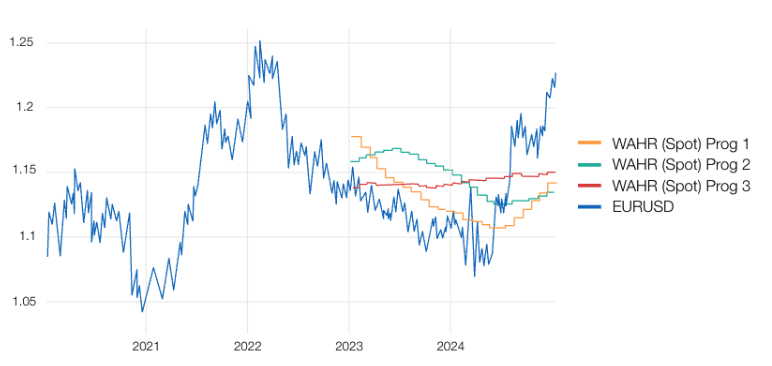
As the chart shows, the longer the program, the more the commonality between hedge rates—and the higher the degree of FX hedge rate ‘smoothing’. It is up to each finance team to decide on the desired degree of ‘smoothing’, based on:
(a.) The competitive landscape faced by the company
(b.) The constraints in terms of the duration, granularity and reliability of its forecasts, and the possibility of trading in long-maturity FX forward contracts.
Configurations: Forwards Points Impact
Treasurers can adapt the configuration of their program to the degree of forward premium / discount of their functional currency relative to others. When selling in forward-discount currencies and/or buying in forward-premium currencies, reducing the impact of unfavourable forward points is made possible by:
- Delaying hedge execution with conditional orders on layers
- Reducing the length of the program
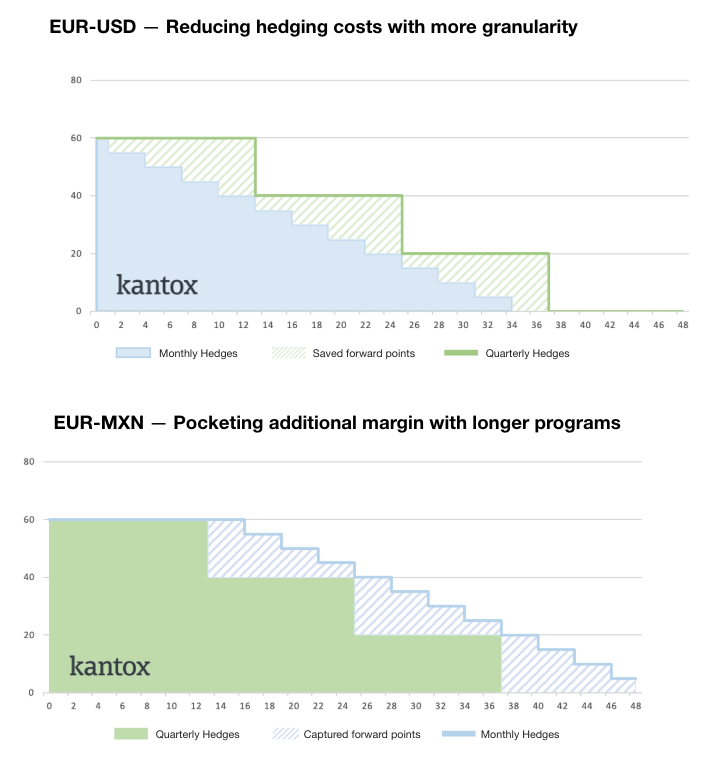
- Increasing granularity (typically from quarterly to monthly)
illustration. A European manufacturer has sales contracts in USD and long-term purchase agreements in MXN. In EUR-USD, it can set monthly instead of quarterly value dates and/or reduce the length of the program. This lowers the average duration of EUR-USD forwards.
The opposite is true in EUR-MXN, where the interest rate differential between these currencies creates the opportunity to capture additional margin by extending the length of the program, thereby increasing the average duration of forward contracts.
Configurations: Program Boosters
FX markets can be monitored 24/5, so that hedge ratios are increased automatically when certain conditions are met. Possibilities include:
- Hedge ratio flexibility. If the spot FX rate moves to a level that managers consider favourable, hedge ratios are increased.
- Maturity flexibility. If the spot FX rate moves to a level that managers consider favourable, program length is increased.
Such ‘boosters’ require different partitions for the EUM (%). For example, a European company with USD-denominated sales can set one partition with conditional orders to delay hedge execution, and additional partitions to be triggered by moves in EUR-USD.
Key Performance Indicators
Companies face cash flow variability when hedge rates jump sharply from one period to the next — the so-called "cliff" effect. KPIs measure the primary objective of layered hedging, i.e., achieving a smooth hedge rate to mitigate the impact of such ‘cliffs’.
Secondary objectives are mostly framed in terms of reducing the unfavourable impact of forward points for companies selling in forward discount currencies. Automated layered hedging programs provide visibility on these and other KPIs.
FAQs


