
Discover essential FX hedging strategies and currency management best practices from our foreign exchange experts.
FX Derivatives Explained: Forwards, Futures, Options and Swaps


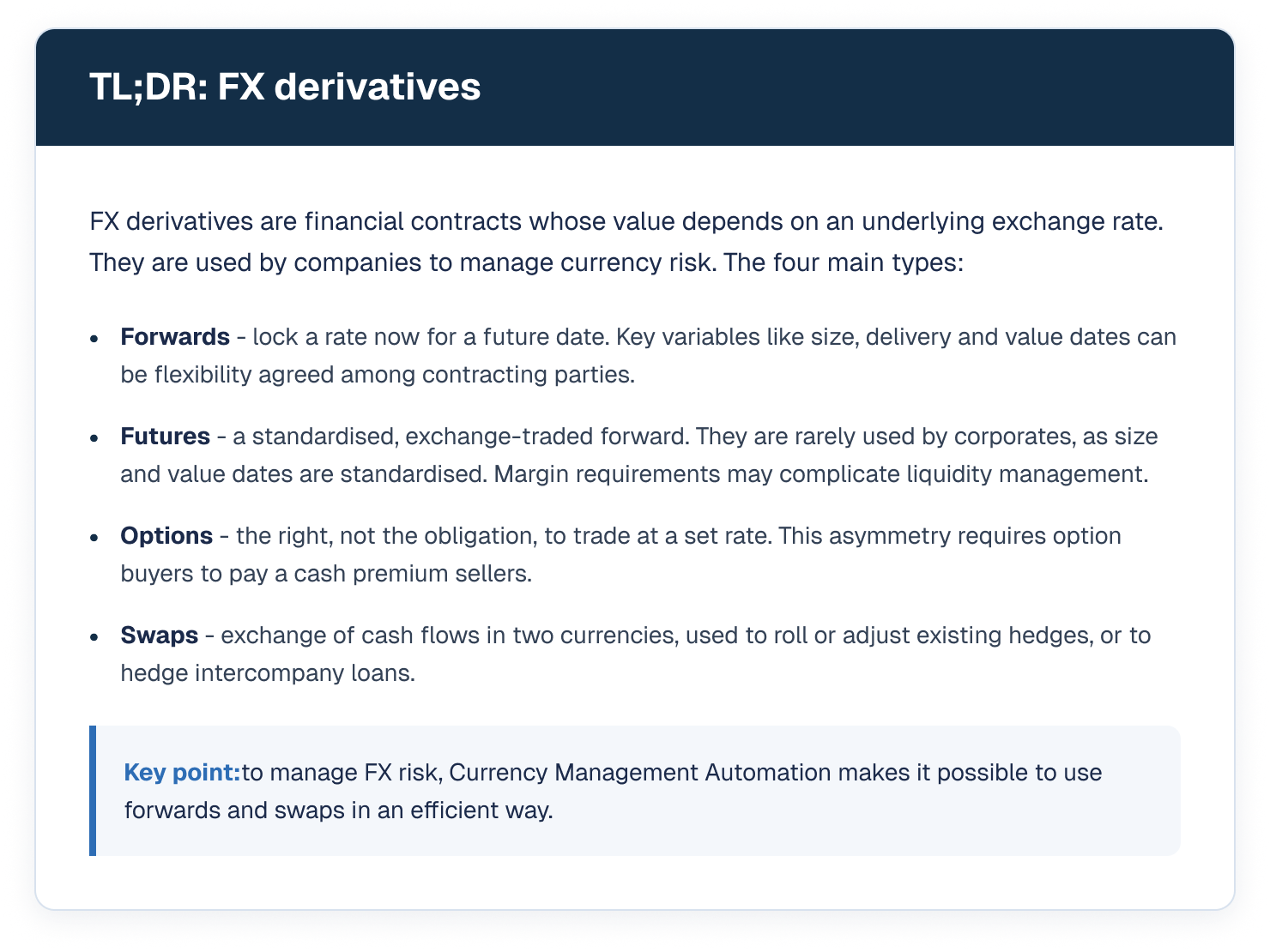
Derivatives are financial contracts whose value is derived from an underlying reference price. In FX derivatives, this reference price is the exchange rate between two currencies. The main FX derivatives are forwards, futures, swaps and options.
Most companies use these instruments to manage FX risk. Currency management, however, extends beyond simply buying or selling a derivative. Natural hedges and the currency composition of corporate assets and liabilities can also protect firms from FX risk.
Technology now allows companies to reduce hedging costs—particularly when interest rate differentials between currencies are unfavourable— by delaying hedge execution. This also allows treasury teams to uncover exposure netting opportunities, reducing the need for derivatives.
What are FX derivatives?
.png)
Forwards. Whereas spot transactions call for delivery and payment within 48 hours, forward transactions settle at a later date—a few days, weeks, months, or even years. Size and value dates are flexibility agreed among contracting parties in OTC markets.
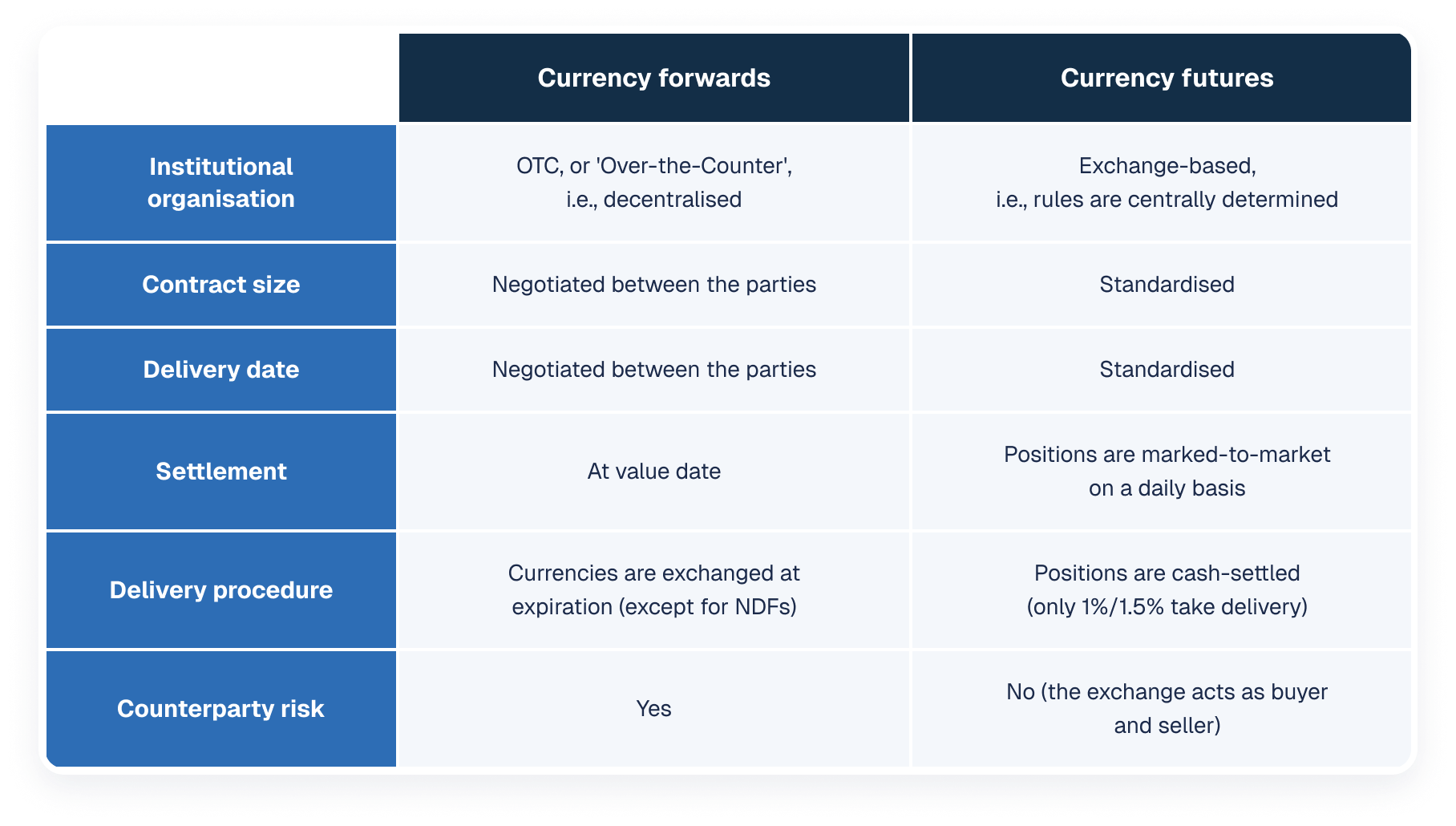
Futures. Unlike forwards, FX futures are traded in regulated exchanges which act as the counterparty to every transaction. Contracts are standardised, both in terms of size and delivery dates, leaving no scope for customisation.
Swaps. Swaps allow firms to exchange cash flows in one currency for another through a number of transactions with different value dates. Swaps can be used on a standalone basis or in conjunction with forwards.
Options. For a limited period of time, the buyer of an option has the right, but not the obligation, to buy a set amount of one currency in exchange for another. In return for this asymmetry, the option holder pays an upfront premium.
FX forwards
A currency forward transaction is similar to a spot FX transaction in that it entails buying one currency against payment of another. The key difference: spot transactions delivery and payment take place within a maximum of 48 hours, but forward transactions settle after that period.
Forward contracts can be negotiated for a few days, weeks, months, a year, or even longer in the most liquid currencies. The market for currency forwards is OTC (Over-The-Counter), meaning transactions take place directly between dealers rather than on a regulated exchange.
In a typical forward transaction, a Japanese company buys textiles from England, with payment of £1 million due in 90 days. Since the GBP-JPY exchange rate will shift during this time lapse, the importer can guard against the underlying currency risk by negotiating a 90-day forward contract with a bank.
.png)
As the exchange rate fluctuates between the moment the transaction is initiated and when it is settled, gains (losses) on the commercial transaction are offset by matching losses (gains) on the derivatives position. Because these currency effects cancel each other out (net of the forward points impact), the company is able to reduce its currency risk.
FX Futures
Like forward contracts, futures contracts specify the amount of the currency to be exchanged, the exchange rate, the delivery or value date, and settlement conditions. Unlike forwards, futures contracts are standardised in terms of size and value date.
Futures are traded in centrally organised markets that act as the counterparty to every transaction. Participants are required to make an initial margin deposit that is subject to increases —known as margin calls— whenever unrealised losses accumulate.
Aside from their standardisation, futures have another drawback: margin calls. Because they generate cash effects that are difficult to predict, they can complicate liquidity management and add to a company's administrative burden.
Currency Options
In currency options, a 'long call' position gives the buyer the right, but not the obligation, to buy a given currency in exchange for another at a predetermined exchange rate (known as the 'strike price' or 'exercise price'), until or at the expiration of the contract.
A long 'put' option has a similar structure, but it gives the holder the right to sell the currency instead. This right comes at a cost: a premium must be paid to the option seller. The value of an option reflects both its intrinsic value and its time value. A call (put) option has intrinsic value if the exchange rate is above (below) the strike price.
Time value, in turn, reflects the probability that the option will have intrinsic value upon expiration. This depends on the volatility of FX markets and on the time remaining until expiration.
FX Swaps
A currency swap is a package of forward contracts with different maturities. The ‘near leg’ of a swap consists of a currency that is bought or sold against another currency with a given value date. The ‘far leg’ of the swap takes the reverse position with a different value date.
In corporate FX risk management, swaps are used in two modalities: on a standalone basis or in the context of existing forward transactions. In the first case, they provide a practical way to fund and hedge FX-denominated intercompany loans.
In the second case, currency swaps are used to amend the value of an existing forward position, by either extending the value date of the transaction or by anticipating it.
Choosing the right derivative: payoffs, cost and automation
Currency risk managers must decide what type of FX derivative to use in their day-to-day activity. This decision depends on several factors, including:
- The type of exposure to currency risk
- The cost of running FX risk management programs
- The related liquidity management issues
It is sometimes argued that currency options leave companies better positioned to avoid scenarios of over-hedging. This occurred on a large scale in 2020 as firms that had hedged with currency forwards overestimated the volume of business.
Yet this argument overlooks recent developments in Currency Management Automation. FX hedging programs can now be configured in a way that reduces the need for highly precise forecasting.
For example, tour operators in the travel industry need to hedge thousands of transactions per year. Since this was not possible in the age of manual execution, they tended to hedge forecasted exposures in bulk.
Treasury teams can now handle any number of FX forward transactions. Because hedges are executed against firm orders, highly accurate forecasts are no longer required. A similar logic applies to layered hedging programs that gradually build up the FX rate.
Thanks to API connectivity, managers can delay hedge execution to reduce hedging costs while uncovering additional netting opportunities. Finally, advances in swap automation seamlessly bridge the gap between liquidity and FX risk management.
Currency Management Automation allows managers to deploy currency forwards without losing sleep over forecasting accuracy, hedging costs, or liquidity management issues. This is why forwards remain the FX derivative of choice for most businesses.
FAQs about FX derivatives
- What are the main types of FX derivatives? The main types of FX derivatives are forwards, swaps, futures and options. They are used by companies to hedge currency risk. Because of their flexibility, forwards are the most widely used derivative product.
- What is the difference between a forward and an option? The main difference is the payoff structure: while forward contracts have a linear payoff with respect to the FX rate, an option buyer can walk away from the obligation to buy or sell.
- Are FX futures and forwards the same thing? They are not the same thing. Forwards trade in OTC markets and have flexible sizes and value dates. Futures are traded in centralised exchanges and have standardised sizes and value dates.
- What is an FX swap used for? Swaps can be used on a standalone basis to fund and hedge intercompany loans. They can also be used in conjunction with forwards to extend or anticipate the value date of an underlying forwards position.
