
Discover essential FX hedging strategies and currency management best practices from our foreign exchange experts.
Foreign Exchange Risk: Types, Causes and How to Manage It


Foreign exchange risk, the degree to which the value of a company is exposed to currency fluctuations, is a key concern for international businesses. According to a 2026 survey by HSBC, as much as 51% of corporates expect to respond to FX risk by increasing their hedging.
When it comes to defining a firm’s exposure to currency risk, relative and discounted cash flow valuation (DCF) take different approaches. Relative valuation starts from an accounting definition of exposure, while DCF valuation requires an economic one.
This article unpacks FX risk by examining four types of exposure: translation, transaction, operating and economic.
What is Foreign Exchange Risk?
Foreign exchange risk is the possibility that currency fluctuations will alter the value of a firm. As exchange rates fluctuate, key valuation drivers can be affected: a company’s profit margins, its competitive position and its ability to generate cash flow steadily.
Some companies are more sensitive to FX risk than others. At firms with substantial profit margins, managers are unlikely to worry excessively about currency fluctuations. In general, high-margin businesses with a small share of foreign currency operations tend to have little or no FX sensitivity.
In the more frequent case of thin profit margins and a considerable weight of FX in the business, however, currency fluctuations may have a decisive impact on financial performance. Such firms have a high degree of FX sensitivity.
It follows that FX risk management, while of secondary importance to low FX-sensitivity firms, is a strategic consideration for any business with low profit margins, sizable foreign currency-denominated operations, or both.
The Four Types of Foreign Exchange Risk
Pricing Risk
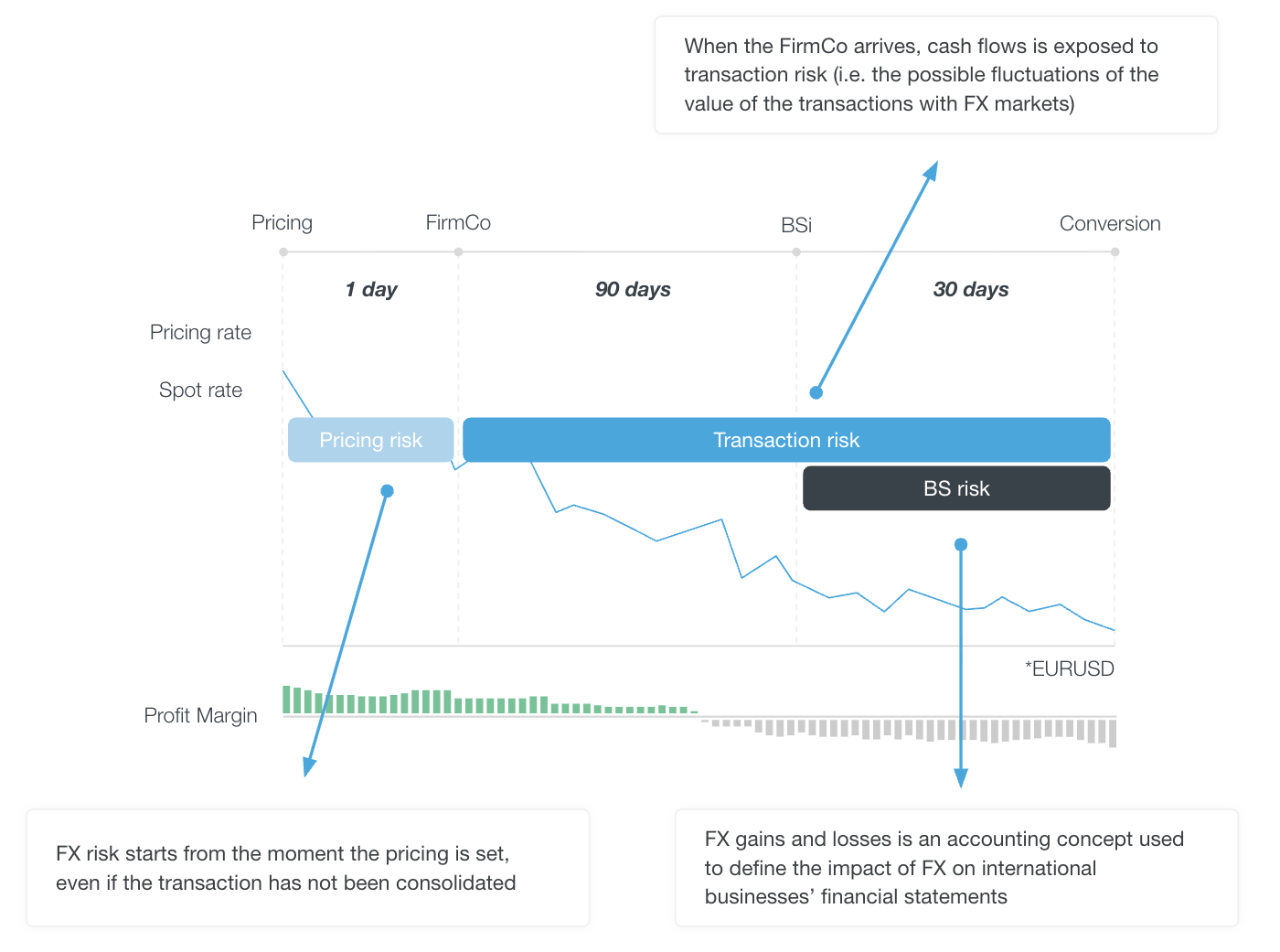
Pricing risk is the risk that exchange rate shifts, between the moment an FX-driven price is set and the moment it is updated, may affect either a firm’s competitive position or its profit margins.
Pricing risk hurts margins if the selling currency depreciates between the moment the FX rate is set and the transaction. If the currency appreciates, the firm’s competitive position suffers, since it could have charged a lower price without affecting its budgeted margins.
The natural way to reduce pricing risk is to update prices more frequently. However, this is often not an option for companies that want to keep prices steady throughout a budget period, or across consecutive budget periods.
Translation Risk
Translation risk, also known as accounting risk, reflects the effect of currency-related changes in income statement items and in the book value of balance sheet assets and liabilities. When these items are translated in the home currency, FX gains and losses arise.
As Alan C. Shapiro notes in Multinational Financial Management, the measurement of accounting exposure is retrospective, because it is based on past activities. Several translation methods exist: current/non-current, monetary/non-monetary, temporal and current rate. Translation does not necessarily involve cash flows.
About 95% of listed companies record the results of balance sheet remeasurement and hedging in the “other income and expense” (OI&E) line. As a result, translation risk bears directly on a company’s earnings per share (EPS), a key financial metric used in valuing the company.
Transaction Risk
Transaction risk is the effect on profitability of exchange rate movements between the moment a cross-currency transaction is confirmed and the moment the currency conversion takes place. The difference between the rate at confirmation and the rate at conversion determines the FX effect on the transaction.
Some elements of transaction exposure, such as FX-denominated accounts receivable and payable, are included in a firm’s accounting exposure, because these items have already been recognised on the balance sheet. However, firm commitments for which no balance sheet items have been created form part of the company’s economic exposure.
Economic Risk
Economic risk refers to the effect of currency fluctuations on a company’s cash flows. It therefore comprises two cash-flow exposures: transaction exposure, derived from firm sales and purchase orders, and operating exposure, derived from forecasted FX-denominated operating revenues and expenditures.
A company faces operating exposure as soon as it invests in servicing a foreign market. Transaction exposure arises at a later stage, when FX-denominated sales or purchases take place. Analysts who use discounted cash flow (DCF) methods to value the firm consider economic exposure the most relevant.
How to Manage Foreign Exchange Risk
Best Practices Before Hedging
Hedging FX exposures means establishing offsetting currency positions to reduce the risk posed by currency fluctuations. Before rushing to hedge, companies should take some preliminary steps to reduce unnecessary exposures and, where convenient, to delay hedge execution.
Prior to hedging, a critical best practice is to reduce exposures through internal actions. Examples include:
- Converting excess non-functional cash balances into local currency
- Settling intercompany payables and receivables across entities with different functional currencies
- Identifying natural hedges within or across entities
Once unnecessary exposures have been removed, managers can use FX forwards, a flexible hedging instrument available for a wide range of maturities.
When selling in forward discount currencies or buying in forward premium currencies, companies should strive to delay hedge execution while still actively managing the underlying currency risk.
Taken together, exposure netting and delayed hedge execution reduce the overall cost of managing risk.
Automating the FX workflow through Currency Management Automation
The FX workflow can be decomposed in three phases: pre-trade, trade and post-trade. Each of these phases comprises a number of steps, as shown in the illustration below.
Automating the FX Workflow through Currency Management Automation
The FX workflow can be decomposed in three phases: pre-trade, trade and post-trade. Each of these phases comprises a number of steps, as shown in the illustration below.
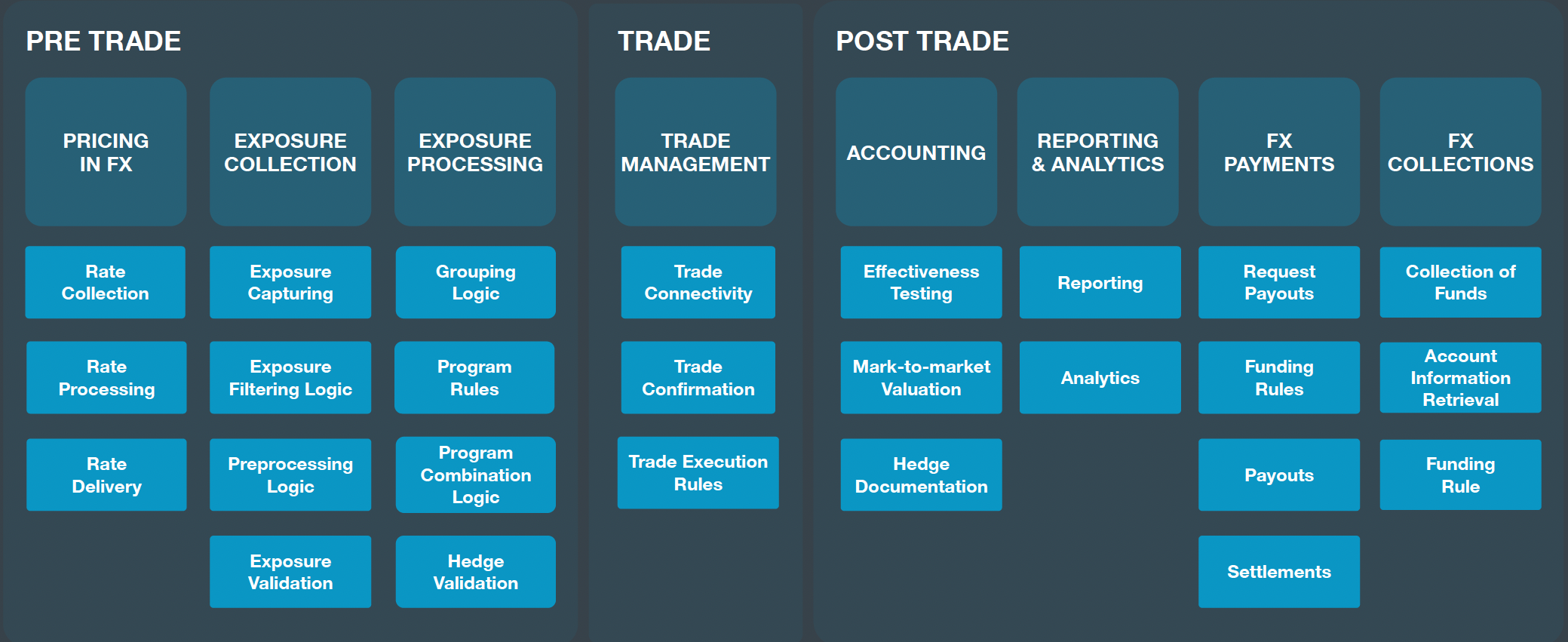
Currency Management Automation starts by having each treasury team creating its own business rules for hedging. These rules govern the FX workflow: exposure validation, the criteria for the inputting, validating and confirming FX trades, and the selection of trading counterparties.
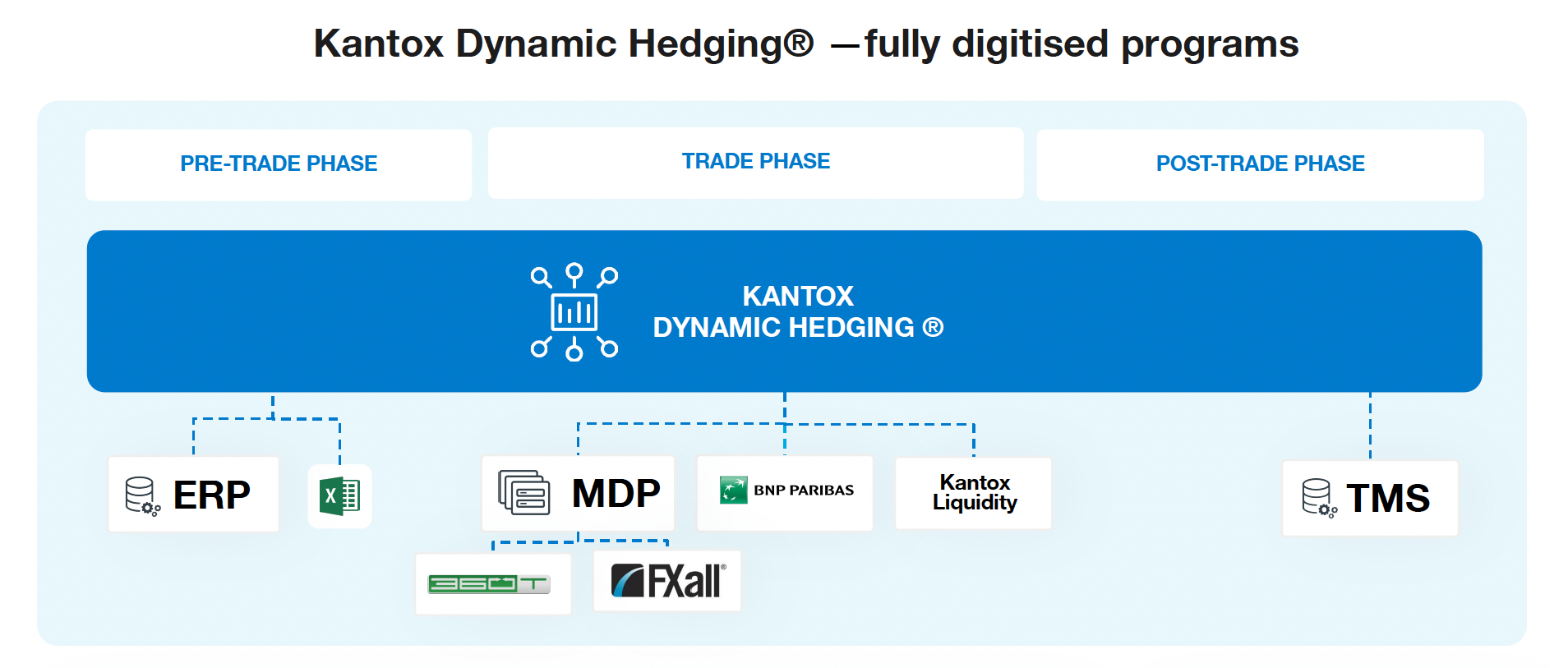
The phases of the FX workflow are with one another, as company systems, including ERP, TMS and others, provide data through API connectivity. Currency managers can send exposure data via API, sFTP, UI or email, while the software automatically filters out incorrect entries.
Because human decision-making is front-loaded, the hedging program itself is executed without human intervention. Automation therefore not only integrates the three phases of the FX workflow but also removes the human element from FX trading decisions.
Automation reduces a number of operational risks. First, API connectivity tames spreadsheet risk: copy-and-paste errors, formatting errors, formula errors and others. Second, the risk of unauthorised FX derivatives trades is contained, as no new input is possible without a validation process.
Hedging FX Risk by Exposure Type
When managing FX risk, companies first need to set their strategic goals. For cash flow exposures, the primary objectives are protecting a budget rate, achieving a smooth hedged rate, or hedging transaction exposure. For accounting exposure, the key goal is to reduce the impact of FX gains and losses on financial statements.
Once these objectives are in place, managers can use a variety of digitalised hedging programs. The main ones include:
- Micro-hedging for firm commitments and balance sheet items (transaction exposure). Individual exposures are aggregated using conditional orders, so that all transactions are protected.
- Static hedging to protect the budget rate, one period at a time (economic exposure). Conditional orders create a corridor around the FX rate being protected, reducing the risk of over-hedging.
- Layered hedging to achieve a smooth hedge rate across a rolling forecast (economic exposure). For each future value date in the forecast, the program builds up the hedge progressively over time.
- Combinations of micro-hedging for firm commitments with static or layered hedging for forecasted exposure (economic exposure). Applying micro-hedging adds precision to the overall program.
FAQs


