
Discover essential FX hedging strategies and currency management best practices from our foreign exchange experts.
FX Risk Management Tools: The 5 Main Types Compared


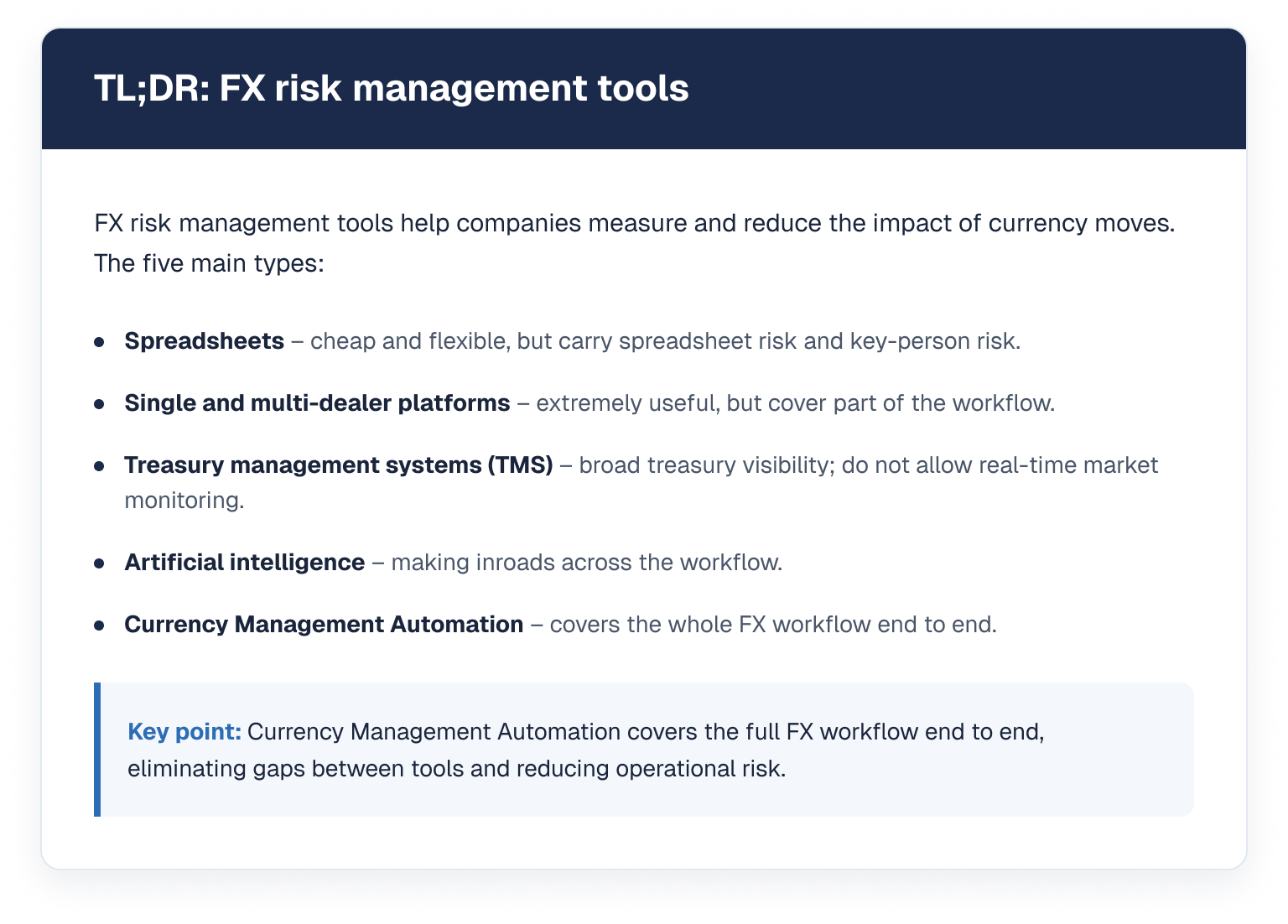
FX risk management tools are the digital resources and platforms corporate finance teams, currency managers, and FX risk managers use to measure, monitor, hedge, and reduce a company's FX-denominated exposure. The main tools include:
- Spreadsheets
- Single and multi-dealer trading platforms
- Treasury Management Systems
- Artificial Intelligence
- Currency Management Automation
The first four tools address different parts of the FX workflow. Currency Management Automation unifies the entire workflow —the pre-trade, trade, and post-trade phases— into a single, streamlined system that incorporates all available tools.
For companies exposed to currency fluctuations, choosing the right toolset affects financial risk, hedging costs, operational workload, and the ability to scale FX management as the business grows. This article compares the five main categories, where each one fits, their benefits and limitations, how automation and AI are changing the process, and what to look for when selecting and using FX risk management tools.
What are FX risk management tools?
Spreadsheets are digital documents that organise data in rows and columns. Because they are cheap and flexible, they are widely used by companies. Managers use spreadsheets to calculate a firm’s exposure to currency risk.
Single and multi dealer FX trading platforms are electronic markets where participants can view price quotes in one interface, compare them, and execute currency trades across spot, forwards and swaps markets.
Treasury Management Systems are software applications built around a file exchange service that allows businesses to communicate electronically with banks to support a broad range of treasury activities.
Currency Management Automation is the process of automating a company's entire foreign exchange workflow end-to-end: from the moment a currency exposure arises, through risk monitoring and hedging execution, to post-trade analysis and reporting.
The main types of FX risk management tools
The table below displays key features of FX risk management tools and how they help businesses improve financial planning and forecasting accuracy, supporting more informed decisions. There is no one-size-fits-all as most companies combine them in different ways as part of a broader risk management strategy.
Currency Management Automation is a case in point: forecasts can be received in spreadsheet form, trade execution is routed to MDPs, TMS provides exposure data, and AI assistants improve forecasts and supply rich post-trade data, which enhances decision-making for businesses.
.png)
Spreadsheets
Across the FX workflow, spreadsheets are widely in pricing, exposure collection and processing, order management, swap execution, accounting and analytics. The appeal of spreadsheets comes from their perceived cheapness and ease of use.
Spreadsheets were originally designed for small pockets of data; they were never designed to handle large amounts of data in an interconnected environment. That’s why companies need to be aware of spreadsheet risk, especially in terms of:
- Data input error
- Copy & paste error
- Formatting errors
- Formula errors
- Multiple versions across the firm
- Lack of backups
- Users’ lack of skills
- Insufficient guidelines
The best antidote against these risks is the use of Application Programming Interfaces to ensure that data can flow seamlessly between different systems (ERP, TMS) and software without any need for spreadsheets.
Corporate FX Trading Platforms
Electronic FX platforms known as single or multi-dealer trading platforms provide corporations with 24/5 access to prices, real-time liquidity, algorithmic execution, and market intelligence across spot, forwards, non-deliverable forwards (NDFs), which settle the difference between the contracted rate and the future spot rate, and swaps.
One of the key attributes of FX trading platforms is the ‘best-price-execution’ feature that puts liquidity providers in competition with each other in spot, forward and swap fx transactions. This can help platforms offer competitive exchange rates and lead to a material reduction in corporate trading costs.
Some platforms also connect with multi currency accounts, allowing businesses to hold funds in various currencies, support international payments, and reduce unnecessary currency conversions.
Single or multi-dealer trading platforms cover the trade phase of the FX workflow. As such, they do not provide the automated connection between the pre-trade phase —where the exposure is collected and processed— and the trade phase, and despite strong execution they still do not manage broader FX services or pre-trade exposure workflows end to end.
Treasury Management Systems
Treasury Management Systems (TMI) are software applications dedicated to treasury management. TMS software is designed to connect to banks through traditional channels, support cash management, and normalize the incoming files into consolidated currency positions. The flip side is that most TMS are unable to connect to modern, API-based finance tooling that allows data to be received continuously in real time.
TMS are therefore unable to monitor currency markets 24/7, and treasury teams cannot track market movements or exchange rate movements continuously when systems are not fed real-time data. This precludes FX managers from implementing cash flow hedging programs that use Stop-Loss and Take-profit orders to delay hedge execution with the aim of continuously updating cash flow forecasts, reducing hedging costs and uncovering exposure netting possibilities, while incomplete visibility can also make teams slower to respond to exchange rate volatility and broader market volatility.
Artificial Intelligence
AI-related tools are increasingly used in corporate FX risk management, and more use cases are sure to come. Some of the most noticeable applications of AI include:
- Short-term cash flow forecasting
- Faster code generation and review
- Post-trade data retrieval
For corporate risk managers using digital treasury solutions, AI assistants can provide 24/7 access to their FX data with all the desired granularity with secure authentication / authorization for agent and tool access.
Currency Management Automation
Currency Management Automation covers the entire FX workflow. It is based on API-based connectivity that allows for continuous, 24/7 real-time market monitoring, a functionality that is unique to this tool and critical when dealing with adverse currency movements and exchange rate fluctuations.
Real-time market monitoring makes it possible for currency managers to optimise interest rate differentials between currencies while uncovering exposure netting opportunities to reduce FX risk management costs. Automation can also support currency swaps, which exchange principal and interest payments in different currencies, while improving visibility into foreign exchange rates and currency values for more effective fx risk management and stronger financial performance.
Currency Management Automation constantly incorporates new technology —including AI-based solutions— in all aspects of the FX workflow, supporting broader hedging solutions and fx services across payments, trade execution, swap automation, hedge accounting automation and many others.
The aim is to make it possible for finance teams to manage fx exposure across multiple currencies and future transactions, and to:
- Systematically reduce FX risk
- Automate manual tasks
- Provide a strong platform to leverage foreign currencies for further growth
Best practices in using FX risk management tools
When choosing the appropriate FX risk management tools, an imaginary constraint leads finance teams to think, first and foremost, in terms of the resources at their disposal. This is not the correct approach. Instead, managers should consider the power of automation and implement a four-stage approach as follows:
- Set the goals of the FX strategy, like defending a campaign or budget rate, achieving a smooth hedged rate over time, or hedging transaction exposure, with goals that reflect the firm’s risk tolerance and home currency exposure.
- Based on these goals, define the best hedging program by selecting tailored hedging strategies and currency risk management choices for future payments and future transactions while imagining that infinite resources can be deployed. Money market hedges use borrowing and investing to replicate forward contracts, while options provide the right, not the obligation, to exchange foreign currency at a set rate and preserve upside. Natural hedging works by aligning revenue and costs in the same currency, and invoicing in the home currency shifts the risk to the customer.
- Consider using tools that seamlessly execute all the steps of the FX hedging program, breaking internal silos and ensuring connectivity with existing systems.
- Only then, prune the strategy and adjust it to the available resources, while measuring the impact —in terms of risk, costs and growth— of this adjustment, helping protect profit margins, stabilize cash flows, and support the company's financial performance amid currency fluctuations and unforeseen events.
In other words: when selecting the appropriate tools, managers should give priority to their firm’s FX goals, not to the resources currently at hand.
FAQs about FX risk management tools
- What are FX risk management tools? FX risk management tools are digital resources and platforms used by corporations to manage currency risk, or foreign exchange risk, along the three phases of the workflow —pre-trade, trade, and post-trade— while automating resource-intensive tasks.
- What are the main types of FX risk management tools? Spreadsheets, single and multi dealer trading platforms, Treasury Management Systems, Artificial Intelligence and Currency Management Automation. Currency Management Automation unifies the entire FX workflow into a single, streamlined system that incorporates all available tools to support international transactions and cross border transactions involving foreign currency.
- What is the best tool for managing FX risk? Currency Management Automation is a comprehensive FX risk management tool that allows for real-time, 24/7 FX market monitoring and visibility into exchange rate changes and currency movements across fx markets. This makes it possible for currency managers to systematically reduce FX risk and hedging costs, while automating time-consuming tasks.
- Are spreadsheets good enough for managing FX risk? No. While cheap and easy to use, the use of spreadsheets involves manual operations that create a long list of operational risks, including data input errors, copy-and-paste errors, formatting errors, formula errors and key-person risk.
- What is Currency Management Automation? Currency Management Automation is the process of automating a company's entire foreign exchange fx workflow end-to-end. It is based on API-based connectivity that allows for continuous, real-time market monitoring, to systematically reduce currency risk and help manage foreign exchange fx risk across currency conversions and exchange currency needs.


